









 सुनचाँदी
 विनिमयदर
 मिति रुपान्तरण
 पेट्रोलको भाउ
 तरकारी / फलफूल
 मेरो एउटा कुरा छ
 AQI
AQI मौसम
मौसम स्न्याप
 रेडियो लाइभ
 बैंक ब्याजदर
 युनिकोड टुल्स
 सेयर मार्केट्स
 राशिफल
 सिनेमा बोर्ड
 निर्वाचन पोर्टल
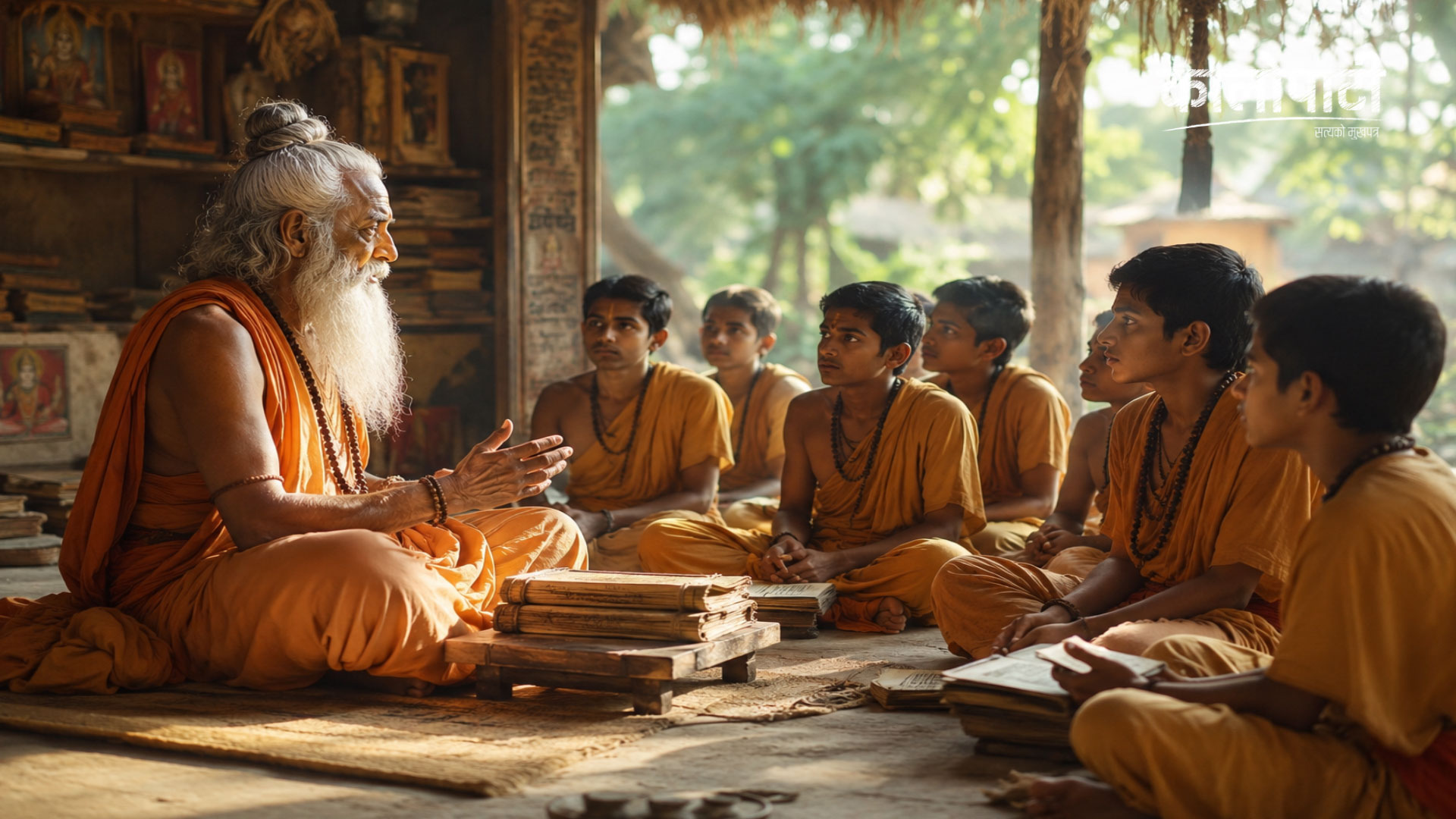

Every year there is a full moon in the month of Ashadha. Messages of greetings are exchanged, gurus are honored, pictures of Maharishi Ved Vyas appear on social media. But one question rarely arises: ‘What are we really celebrating?’ A religious festival, a birthday of a historical figure, or a wonderful tradition of civilization that has kept knowledge alive for generations?
Before understanding Guru Purnima, one should understand Vyasa and before understanding Vyasa, one should understand the nature of the Vedic tradition. The Vedas are not written by any one person at any one time. In the Vedic tradition, it is considered to be the Sanatani knowledge experienced by the sages. That knowledge was preserved from the Shruti tradition for generations. With the passage of time, society changed, human memory weakened, branches of Vedic studies spread. At that moment, an extraordinary task was accomplished. At the center of this work was Maharishi Krishnadvaipayana Vyasa. Which was later named Vedavyasa. Maharishi Ved Vyas who is not new to Nepali society. From village temples to university Sanskrit departments, from religious discourses to literary gatherings, his name is uttered. Here is the answer to the question of why tradition calls him ‘Vedavyas’. He did not compose the Vedas; He arranged the Vedas. He simplified the study and preservation of the vast Vedic knowledge by dividing it into Rigveda, Yajurveda, Samaveda and Atharvaveda. The question of what would have been the continuity of Vedic knowledge had it not been done is of interest to historians even today.
This is why his contribution is not limited to any one book. The ancient civilization has remembered and understood the Mahabharata, Brahmasutra, the tradition of the eighteen Puranas and the systematic preservation of Vedic knowledge etc. by connecting them with one personality. The reverence expressed for Vyasa in the Adi Parva of the Mahabharata is a reflection of this: “Vyasaya Vishnurupaya Vyasaroopaya Vishnu. Salutations to the treasure of Brahman, salutations to Vasishtha. This is not just praise; It is an expression of civilization’s gratitude to knowledge. Therefore, Guru Purnima is also known as Vyasa Jayanti. In fact, it is more than a celebration of an individual’s birth, a celebration of an ancient tradition of streamlining knowledge.
In this context, another question arises, “Why is the position of the Guru so high?”TAG_OPEN_p_21 The teacher can teach the subject and the guru gives the vision. The teacher can give the answer, the teacher teaches to ask questions. Teachers can help earn a living, gurus help to understand life. So the word ‘guru’ doesn’t just mean a profession; There is also a state of consciousness. It is also said in the Shvetashvatara Upanishad that “Yasya Deva Para Bhakti Yatha Dev Tatha Gurau.” These words have been narrated by him that shine forth in the great soul. (6.) 23. “It does not mean to worship the person of the Guru. Its purpose is to create an ability to acquire knowledge. Where the ego decreases, the ability to learn increases. This psychological truth is expressed in the spiritual language of the Upanishads. Ancient cultures have further widened the scope of the Guru. The famous saying of the Taittiriya Upanishad is “Mother, O God.” Be one for whom the father is a god. Be one for whom the teacher is a god. This indicates that the journey of knowledge starts from the family and reaches the Acharya. Therefore, a guru is not just a sage or a spiritual saint in an ashram; It can be anyone who gives life the right direction.
In my opinion, the biggest message of Guru Purnima is that where knowledge is not enough in itself, it is equally necessary to pass it on.TAG_OPEN_p_20 History showed many civilizations, where there were books but no traditions; As a result, knowledge was lost. In our neighboring country India, the Guru-Shishya tradition has been transmitting not only the scriptures but also the experience. Perhaps it is for this reason that Vedic knowledge is still alive to some extent there. Today we are in the age of information technology. A mobile phone can open books all over the world. Artificial intelligence can provide answers in a matter of seconds. But one question remains: “Why are people struggling to make the right decisions in an age of readiness to make information?” Equipment is sufficient to collect information. Studying is needed to build knowledge. But prajna is that experience, a discipline, that develops only through dialogue and guidance. That’s why technology hasn’t eliminated the need for a guru; Instead, the role of the Guru has been given a new meaning. Therefore, Guru Purnima is not just a memory of tradition. It is also a historical document of how a civilization respected knowledge.
Let’s look back about a century or two, where if someone wanted to gain knowledge, he would go to the library, go to a gurukul, or take refuge in a scholar. Today, the scene has changed. A mobile phone can display books, lectures, and research from all over the world in an instant. Artificial intelligence answers the question within seconds of being asked. In such a situation, the natural question arises, “Why is there a need for a guru when everything is so readily available?” Information and knowledge are not the same thing. It’s one thing to know the facts; It is another thing to understand these facts in the right context. Connecting that knowledge with life decisions, character, and behavior is a different matter. Technology has made the first job easier; The other two tasks are still in the hands of man. Thus, the ancient tradition did not consider knowledge to be merely a matter of memory. The value of knowledge was discovered in its application. The role of the Guru also starts from here. The Guru not only answers but also teaches which questions are important. Often, life-changing questions are not the answer, but the right questions.
This sentiment is also seen in the Bhagavad-gita. Lord Krishna says to Arjuna: Taddhi pranipaten pariprashnena sevaya. The wise who have seen the truth will teach you knowledge. (Bhagavad Gita 4. 34. It is important to note that here Shri Krishna is not just saying to Arjuna, “Believe me”. He has also asked to ask questions. But that question must be born out of curiosity, not ego. This difference is the power of the ancient knowledge tradition. Neither blind devotion nor blind rejection is acceptable here. Perhaps this balance seems to be being lost the most today. It is natural to have disagreements in public life. One can disagree with the views of a teacher, teacher or spiritual master. Their interpretation can be reviewed. Research can be challenged. The world of knowledge proceeds from such debates. But in the last few years, I have noticed that ridicule is more than debate, personal attacks are more than arguments, and insults are more than disagreements. Social media expanded opportunities for expression, but with it a test of restraint.
This problem is not just in one area. School teachers, university professors, researchers, Sanskrit scholars, spiritual speakers, etc. are not untouched by this change. It is not unusual to be criticized; But if the tendency to look at the person who gives knowledge with distrust continues, it will ultimately undermine social trust in knowledge. This does not mean that everything that happens in the name of the Guru is right. The ancient tradition has placed religion and truth above the guru. From the Mahabharata to the Upanishads, there are examples of questions being raised on the idea of the Guru wherever necessary. So the question of dignification is not against the Scriptures; Rather, it is part of the classical tradition. But the habit of treating questions and insults as the same damages the culture of knowledge and dialogue. The society in which we live should not forget that civilization is not only built by the new generation. The new generation adds to its contribution by standing on the foundation of knowledge received from the previous generation. If respect for that foundation is lost, new construction will not last long. This is the reason why all the developed educational traditions of the world seem to have tried to maintain institutional respect for teachers, researchers and scholars.
TAG_OPEN_p_16 This is also the meaning of the remembrance of Vedavyasa. He did not create a new civilization; He organized the knowledge that had already flowed. Even today, every teacher, every researcher, and every honest teacher is doing the same work in some form or the other, that is to pass on knowledge to the next generation. Therefore, Guru Purnima asks today’s generation a simple but serious question: “Do we want to be an information-gathering society or a knowledge-building society?” Guru is the name of the bridge that crosses that distance.
But while studying astrology, philosophy and Sanskrit texts for the last few years, one thing has happened again and again. Rather than the decrease in the number of people who read the Scriptures, the number of people who vote on the Scriptures without reading them has increased significantly. This tendency seems to have developed the concept of becoming a guru or a guru. Some spread superstitions in the name of the Guru, while some reject the entire Guru tradition in response. Both of these are extremisms. The sages showed neither the first path nor the second. One of the beautiful features of the ancient tradition of knowledge is that it is not forbidden to ask questions. In fact, much of the Upanishads begins with curiosity. Nachiketa asked Yama, Gargi questioned Yajnavalkya, Arjuna asked Sri Krishna. If the questions were not asked, all these conversations would not be possible. So the first sacrament taught by the scriptures is not tacit confession; It is a curiosity to find the truth. But curiosity and disrespect are not the same thing. This is the reason why an important sutra is found in the Manusmriti: ‘Abhivadamīśilasya nitya vṛddhaopasevinah’. Four things increase in him: longevity, knowledge, fame, and strength. (Manusmriti 2.) 121) This verse presents honor not as a religious ritual, but as a basis for personality development. It also means that one who is humble, who has the intention of learning from elders and teachers, develops the four qualities of longevity, knowledge, fame and strength. The fruit of honor here is not merely spiritual; It’s also social and intellectual. There is a paradox in our society today. Schools are taught to respect their teachers, but in public life there are also scenes where teachers, professors, researchers or spiritual personalities are treated in derogatory language. Social media has given everyone a chance to speak, but not all expressions are rational. Dissent is the basis of a civilized society, not an insult. Criticism refines knowledge; Contempt ends the dialogue.
There is another aspect to remember on the occasion of Guru Purnima. Respecting the Guru does not mean accepting his every statement as the ultimate truth. In the same way, it is not fair to reject the entire Guru tradition just because a guru or a teacher is weak. Ancient philosophy has always promoted wisdom and faith together. Knowledge without faith can turn into ego; Faith without rationality in superstition. The life of Ved Vyas also teaches the same lesson. He did not create a new Veda, nor did he call himself the ultimate source of knowledge. He organized the knowledge that preceded him, preserved it, and paved the way for future generations. The characteristic of any great teacher is that he does not try to make the pupil copy himself; Enables him to think independently.
Today we are in the age of artificial intelligence. The answer will be available in a few seconds. But no technology has yet been able to answer one of my questions, “What knowledge to use in life?” The teacher does not add information; They give you vision. The book gives the facts; The Guru gives references. Scripture gives principles; The Guru shows its use. Perhaps that is why Guru Purnima is new every year. Its relevance is not because the character has changed, but because the question remains the same. What kind of society are we building? A society that respects knowledge, or a society that consumes only information? A society that sees teachers as nation-builders, or a society that respects them if necessary and insults them when they disagree? The answers to these questions are not found in any book. The answer comes from our behavior.
The actual celebration of Vyas Jayanti and Guru Purnima is not limited to temples, ashrams or schools.TAG_OPEN_p_12 This is accomplished when a student learns to ask questions but does not forget the dignity; When a guru imparts knowledge but does not nurture ego; And while a society may disagree with an idea, it preserves the dignity of the person who imparts knowledge. This is perhaps the greatest teaching of the ancient Gurushishya tradition. Civilization does not become great merely by producing new knowledge; Long-term life is achieved only when you can create new knowledge by respecting old knowledge. Guru Purnima and Vyasa Jayanti remind us every year that the light of knowledge should not be extinguished, because the real future of civilization is secured in that light.
प्रतिक्रिया दिनुहोस्