







 सुनचाँदी
 विनिमयदर
 मिति रुपान्तरण
 पेट्रोलको भाउ
 तरकारी / फलफूल
 मेरो एउटा कुरा छ
 AQI
AQI मौसम
मौसम स्न्याप
 रेडियो लाइभ
 बैंक ब्याजदर
 युनिकोड टुल्स
 सेयर मार्केट्स
 राशिफल
 सिनेमा बोर्ड
 निर्वाचन पोर्टल

Kathmandu. The government has introduced a new legal provision to solve the problem of waste management that has been complicated for years. The bill to amend and integrate the laws related to the management of waste registered in the House of Representatives, 2083 has proposed to strictly regulate the issues ranging from waste generation to collection, transportation, processing and final disposal.
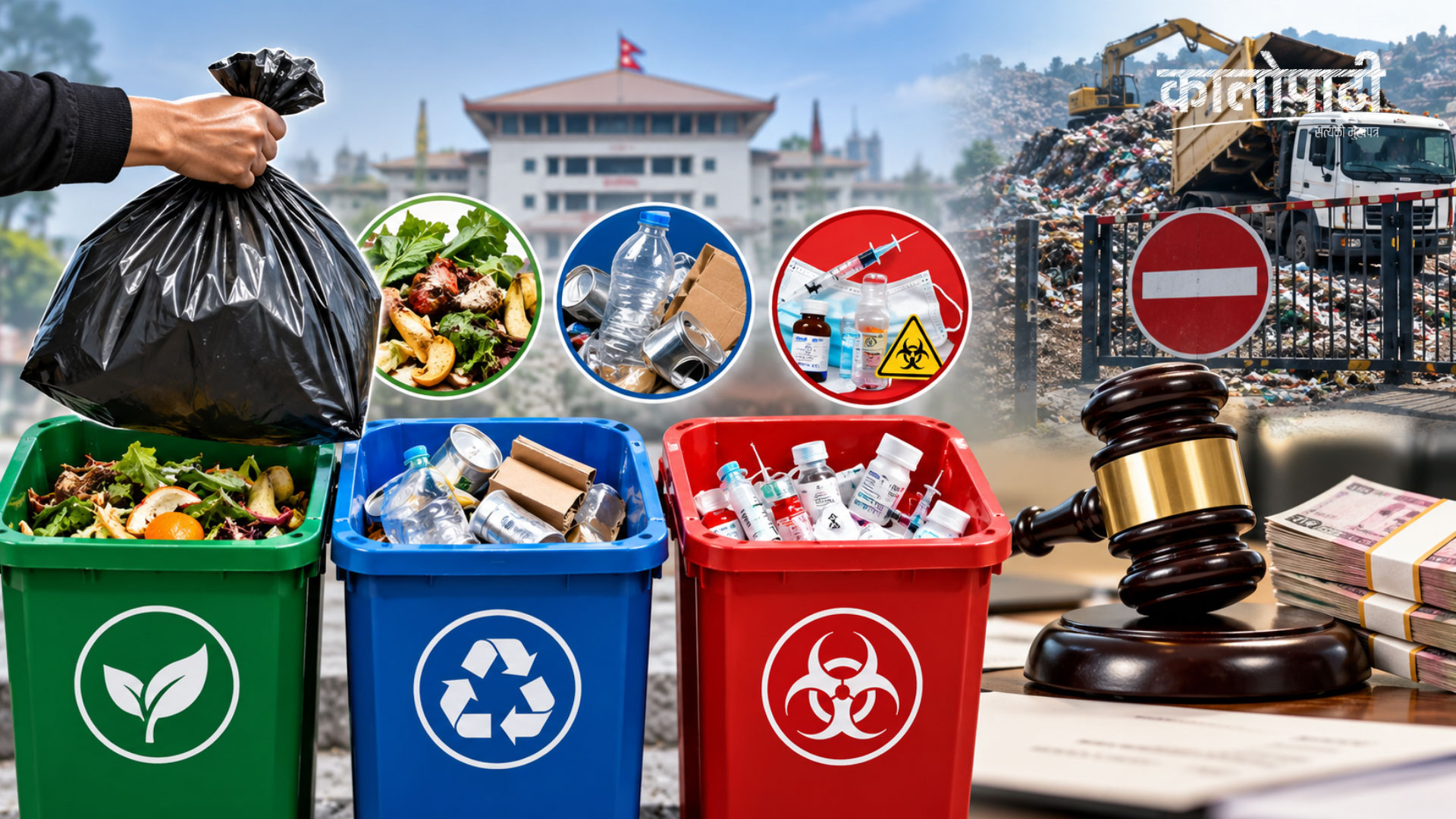
According to the proposed provision, the waste generated from homes, offices, businesses, industries and health institutions will now have to be divided into three categories: degradable, non-degradable and hazardous. The local level will determine the time, place and method of collection according to the nature of the waste. Separate dustbins will have to be kept for all three types of waste in public roads, parks, bus parks, etc.
The system of segregation of garbage
will not be limited to collection only. It has also been proposed to make it mandatory to have at least three separate chambers {{TAG_CLOSE_strong_20 TAG_OPEN_strong_20}} for the vehicles transporting garbage. For this, it has been proposed that the local level should make standards within three months of the implementation of the law and the vehicles that do not meet the existing standards should be made three chambers within six months.
The person who mixes the garbage without separating the source will be TAG_OPEN_strong_19 fined Rs. 500 fine. Similarly, if the institution, industry or agency commits such a mistake, a fine of Rs. TAG_OPEN_strong_18}} will be imposed on each time. A fine of up to TAG_CLOSE_strong_18 Rs. 50,000 has been proposed. The local level can stop the waste collection service of the person or organization who violates the rules or does not pay the service charge.
TAG_OPEN_p_30Strict action is also proposed against those who obstruct the waste management. A person who obstructs the collection, transportation or disposal of garbage, closes the road, gheraos or strikes will be fined Rs. TAG_OPEN_strong_17}}. A fine of Rs 10,000 to Rs 50,000, imprisonment from 15 days to three months or both can be imposed. Provision has been proposed to investigate such an offence by the Nepal Police and to proceed with the case through a public prosecutor.
The bill also proposes a complete ban on dumping of garbage in rivers, streams, lakes, wetlands and watersheds. The sewage that is currently being mixed into the rivers and streams will also have to be treated and managed safely within three years of the enactment of the law.
TAG_OPEN_p_28 More stringent provisions have been made for hazardous waste. It is proposed that the responsibility of management of chemical, radioactive, electrical and other hazardous waste emitted from hospitals, industries and various institutions will be on the concerned producer or institution. If hazardous waste is dumped elsewhere than the designated place, it will be fine Rs. . A fine of up to Rs 10 lakh can be levied and the cost of management can also be recovered. If necessary, the business of the concerned industry or establishment can also be stopped.
Similarly, manufacturers and importers of batteries, tires, electronic goods and plastic products will have to operate a ‘take-back system’ {{TAG_CLOSE_strong_15 TAG_OPEN_strong_15}} to collect them back after use. A provision has been proposed to control and ban single-use plastics in a phased manner, while plastic bags that are not of good quality can be confiscated and destroyed.TAG_OPEN_p_27
It has also been proposed to ban the open burning of garbage. For energy generation or co-processing, waste can be used only through the approved process of the government.
On the infrastructure side, it is proposed that the waste transfer center should be at least 5 ropanis { and the processing center should be at least 50 ropanis{ in area. Arrangements have been made to have a material recovery facility, compost fertilizer plant, incinerator and crusher plant in the processing center.TAG_OPEN_p_25
TAG_OPEN_p_24 The bill also gives priority to the locals in the landfill areas affected by the waste management. It has been proposed that at least TAG_OPEN_strong_12 70 percent of the remaining income should be spent on the social, physical and economic development of the affected areas and local residents TAG_CLOSE_strong_12. The bill also includes giving priority to employment to the locals, subsidizing compost, fertilizer and energy, and creating a mechanism for local participation to resolve disputes.
Thus, the proposed bill aims to manage waste as a TAG_OPEN_strong_11 reusable resource rather than as a mere disposal item and to clearly TAG_CLOSE_strong_11 provide for responsibility and penalties from waste generation to final disposal.
प्रतिक्रिया दिनुहोस्