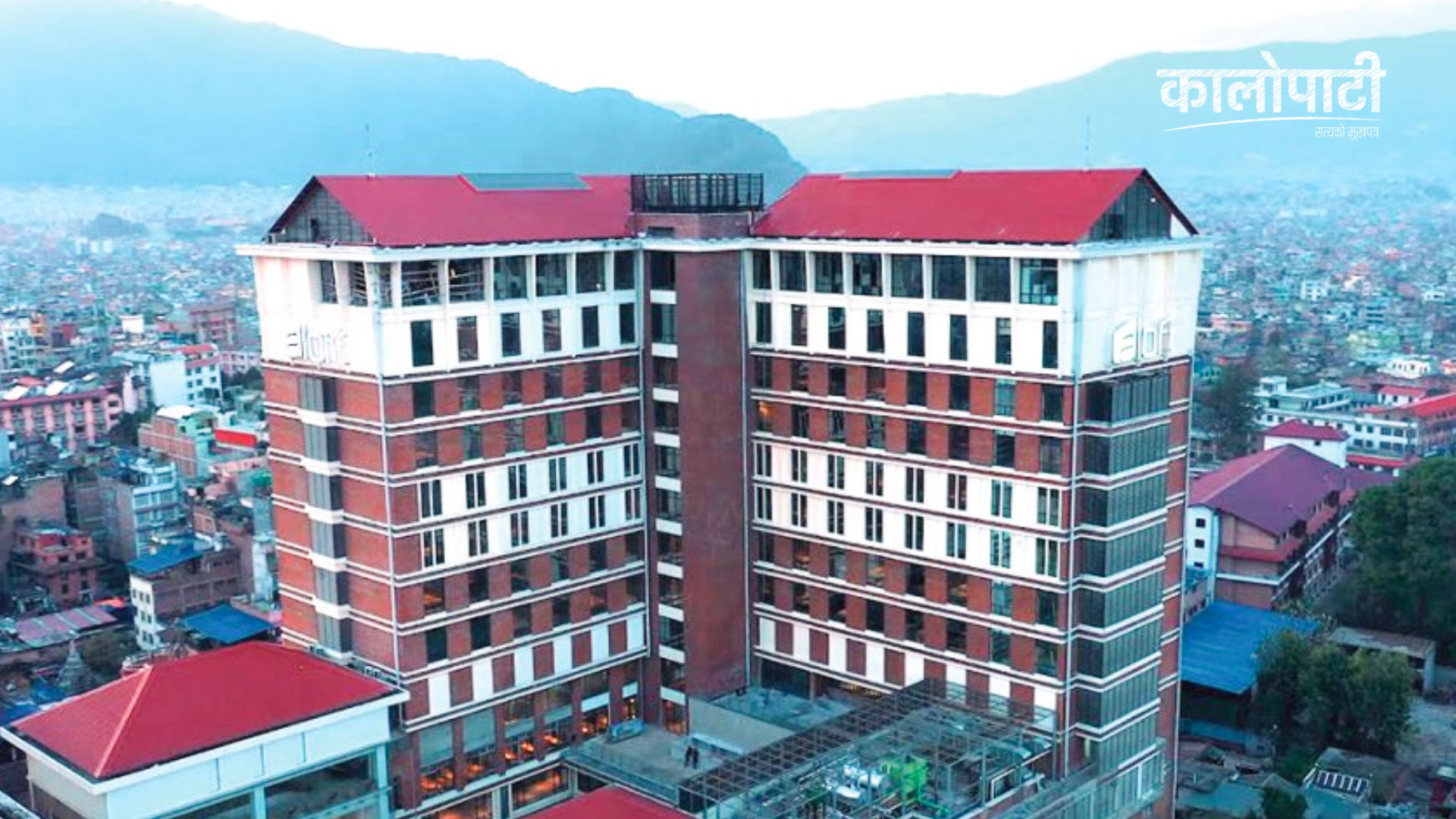
. An attempt has been made to drag the Chhayadevi Complex, a modern commercial hub located in the heart of Kathmandu’s tourist hub, Thamel, into unnecessary controversy by linking it with cultural heritage.
However, if we analyse the evidences from 1967 B.S., the records of the Guthi Sansthan and a series of court judgments, it is proved that this land is not public land under any circumstances but is a private land with full legal rights.
The first strong basis of the legal rights stipulated in 1967 was that Nepal did not have the constitution and rule of law as it is today.
The country was governed by the orders of the rulers under the Rana regime and the dictates of Shree 3 Maharaj were considered to be the highest legal basis. Under this provision, On February 11, 1967, by the decree of Shree 3 Maharaj (Chandra Shumsher), about 26 ropanis of land belonging to Bhagwan Guthi was transferred to the name of Keshar Shumsher.
TAG_OPEN_div_114 Since such an order was applicable as a law during the Rana regime, it is clear that Keshar Shumsher has the legal right and right to use the land. Historically, in 1967, only Kohiti, Maruhiti and Thahiti were specifically defined in Kathmandu
And most of the rest of the land was distributed by the state or by specific order. So far, no law has been made to nullify such a right established by the dictates of the rulers.
Therefore, it is irrational to call the land legally obtained by the order as government or public today. Former Kathmandu District Court Judge Bijaya Pratap Rana The verdict dated Baisakh 25, 2030 BS had legally confirmed that the land was transferred from the allotment to the name of Keshar Shumsher.
Similarly, a division bench of Justices Gamma Dutta Tiwari and Jagannath Upadhyay upheld the decision of the District Court in 2031 BS and gave the final verdict that Keshar Shumsher was the tenant of the land.TAG_OPEN_div_109
According to the said judgment of the Regional Court, the letter from the Guthi Sansthan and the A letter to the court dated Shrawan 30, 2028 BS clarifies that the registration was registered in the name of Keshar Shumsher. The same decision shows that the tenant who acquired the land and the owner of the land was Keshar Shumsher himself.
Thus, after the letter of the Guthi Sansthan and the court verdict have confirmed that both the tenant and the landowner are Keshar Shumsher, there is no place for this land to be made public. The legal status of the land ownership and transfer of rights has been established in the legal history of Nepal. The provision of making formal land ownership certificates started only in 2021 BS.
According to the rule of law, once the state issues a land ownership certificate, either the heir concerned has to relinquish his right or the government must nationalize it by paying compensation.TAG_OPEN_div_103
Neither the landowners have given up the right to the land of Chhayadevi Complex, nor has the government made it stately. Since neither of these things has been done, it is another irrefutable legal basis that the land of the Shadow Center is private, not public.
If the title is not transferred legally, the court cannot take over the land even if it wants to.
The commentary that is being made about how the historical pond has been destroyed in the market is just a misconception and a rumor. If there was a historical or public pond in the place where the present Chhayadevi complex is located, then in ancient times there would have been a public road or road to reach it.
Although other historical ponds in the capital (such as Ranipokhari, Kamal Pokhari, etc.) have a provision for public movement from all sides, this place did not even have a trail road in the past.TAG_OPEN_div_95 By 1977 B.S., Keshar Shumsher had enclosed the area with a high wall and included it in his private palace premises.
Since then, the public has been completely closed to the public, and there is no evidence in the history of any public religious activities, fairs, festivals, or community events.TAG_OPEN_div_93
Maheshwor Shrestha, a resident of Asan in Kathmandu, who is also the managing director of Chhayadevi Complex, said that after the construction of the complex, the entrepreneurs themselves purchased the road from the surrounding landowners for commercial purposes.TAG_OPEN_div_91
The road that is currently used to enter the Chhayadevi Complex was constructed only after purchasing it from Guthi and local Panchalal Maharjan.TAG_OPEN_div_89 The fact that the entrance to the complex had to be privately purchased proves that the site was previously a completely closed piece of land within a private premises, with no public access.
In the year 1967, the date of the In 2030, the District Court and Irrefutable facts and evidences such as the landmark verdict of the regional court in 2031 BS, the Guthi Sansthan’s own records, the legal provisions related to land ownership and the lack of a public road historically, prove that the land built in the Chhayadevi Complex is entirely privately owned.
Therefore, without any historical or legal basis, this land cannot be called public merely on the basis of rumors spread in the market and misinterpretations. It has become clear legally and practically that this land is not public under any circumstances g.




 सुनचाँदी
 विनिमयदर
 मिति रुपान्तरण
 पेट्रोलको भाउ
 तरकारी / फलफूल
 मेरो एउटा कुरा छ
 AQI
AQI मौसम
मौसम स्न्याप
 रेडियो लाइभ
 बैंक ब्याजदर
 युनिकोड टुल्स
 सेयर मार्केट्स
 राशिफल
 सिनेमा बोर्ड
 निर्वाचन पोर्टल

प्रतिक्रिया दिनुहोस्