









 सुनचाँदी
 विनिमयदर
 मिति रुपान्तरण
 पेट्रोलको भाउ
 तरकारी / फलफूल
 मेरो एउटा कुरा छ
 AQI
AQI मौसम
मौसम स्न्याप
 रेडियो लाइभ
 बैंक ब्याजदर
 युनिकोड टुल्स
 सेयर मार्केट्स
 राशिफल
 सिनेमा बोर्ड
 निर्वाचन पोर्टल
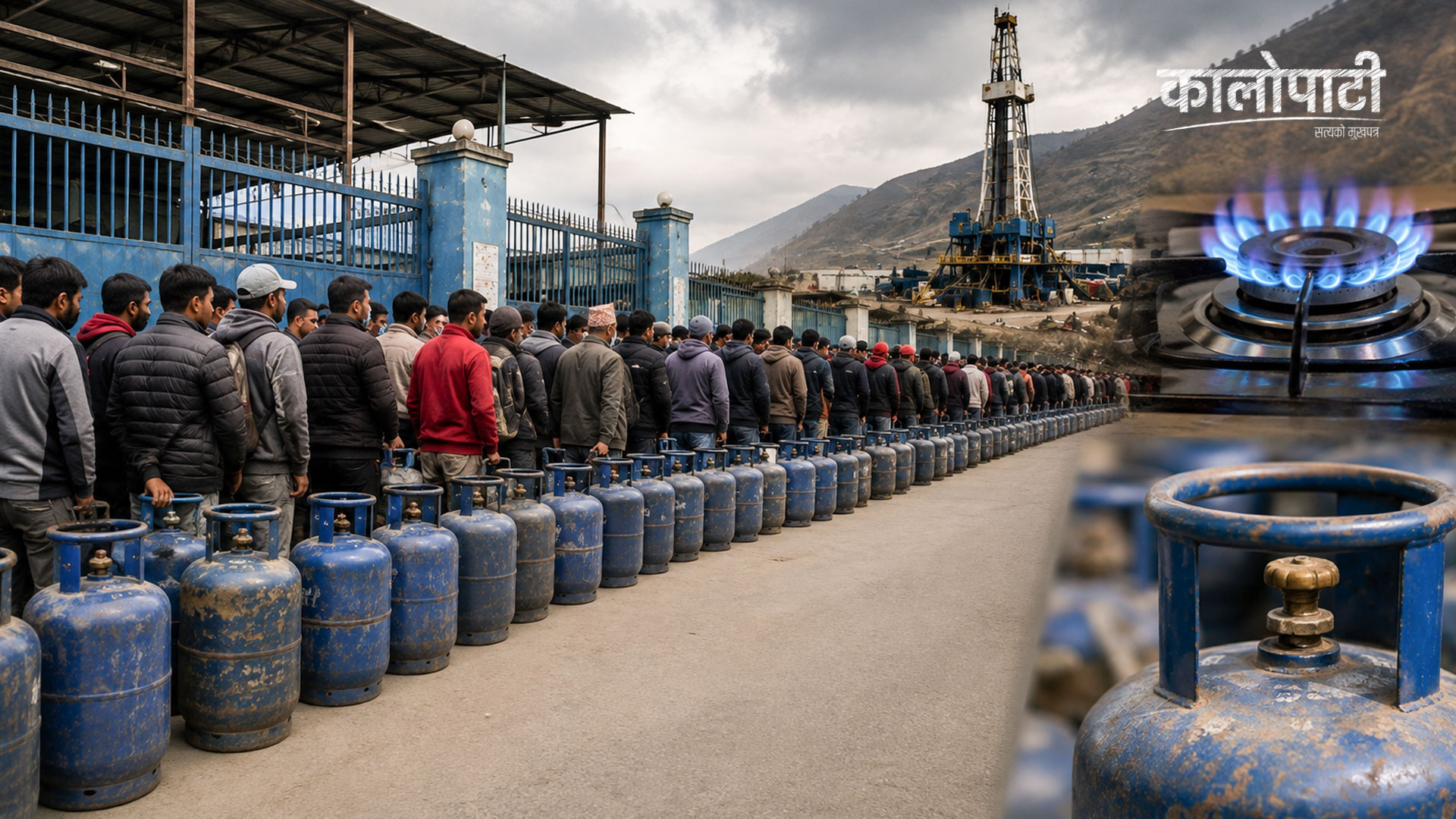

Disturbing scene of Balaju Industrial Area and the cries of the consumers
}
} A disturbing scene was seen outside the gate of the Nepal Gas Industry inside the Balaju Industrial Zone in Kathmandu on Sunday morning. Hundreds of people lined up with empty blue cylinders , }, some of whom had been waiting for their turn since the night before. The fact that consumers are compelled to go directly to the distribution center of the industry as they do not get gas in the depots in the market shows how weak our supply system is. The compulsion to wait for weeks to exchange a single gas and return empty-handed from the dealers has created extreme resentment among the citizens against the government.
Broken supply balance when going from half to full cylinder
}
Nepal Oil Corporation (TAG_OPEN_span_146 NOC) had decided to distribute full-weight (14.2 kg) cylinders in place of the half-filled (7.1 kg) cylinders from July 14 for the convenience of consumers and the demand of the market. Earlier, in 2082 BS, due to the acute shortage of gas, the corporation had brought the concept of half cylinder to manage the market. However, , } Now that full capacity cylinders are being sent to the market, there is a sudden problem in the supply system, }, due to which the market that is just trying to return to rhythm has become chaotic again.
Wide gap between the claims of the oil corporation and the consumers
}
Nepal TAG_OPEN_span_141 Oil Corporation (NOC) has been claiming that the import of LPG from India is in full capacity and there is no shortage in the market. Although the officials of the corporation have presented statistics that the import of gas is more than the demand, the actual scene of the market is quite opposite. Hanging boards in depots saying ‘No gas‘ } and consumers roaming the streets carrying empty cylinders confirms that there is a huge gap between the corporation’s claim and the ground reality. which is affecting the consumers.
Students and small families directly affected by gas shortages
}
Students and small families are among the hardest hit by the latest gas shortage.TAG_OPEN_span_134 For students studying in rented rooms in Kathmandu, arranging a cylinder of gas is now like winning a war. Small families who are dependent on daily wages , } have been forced to leave work and live in gas lines, not only their stoves but also their daily income, {{TAG_OPEN_span_130}. This problem has badly affected the life of the people in the urban areas.
Artificial scarcity created in the market and lax government monitoring
}
Consumers have blamed artificial shortages for the shortage of gas in the market. They believe that the problem has been exacerbated by activities such as the lack of supply and demand balance or the activities of traders hiding stocks. In such a sensitive time, the lack of strict monitoring and action by the government agencies seems to have further encouraged the black marketeers. The general public has strongly demanded the government to immediately monitor the market and ease the supply.
Fuel{ New Price:} Decision to Scratch the Back of the Common Citizen
}
Another big blow to the Nepali consumers who are facing a shortage of gas , TAG_CLOSE_span_127{{TAG_OPEN_span_126} when the Oil Corporation increased the price of petrol, }. Now, the price of petrol in Kathmandu has reached Rs 200 per liter TAG_OPEN_span_122 TAG_CLOSE_span_123 TAG_OPEN_span_123 TAG_CLOSE_span_124, which is one of the highest points so far. Due to the increase of Rs 5 per liter in diesel and kerosene and Rs 3 per liter in petrol, transportation and transportation services are sure to become costlier {, } which will have a direct impact on the overall price of the market.
IOC Price List and Corporation’s Obligatory Adjustment
Nepal Oil Corporation (NOC) has argued that it had to adjust the price after receiving a new price list from the Indian Oil Corporation (IOC).TAG_OPEN_span_119 According to the list received on Saturday, the price of petrol and diesel has increased drastically and the decision was taken only on Sunday due to public holiday. Although the corporation has claimed that the price has been increased only less than the ratio sent by the IOC so that the consumers do not have to suffer much, the increase in the psychological limit of Rs 200 has caused extreme disappointment among the consumers.
The increase in aviation fuel and the inflation cycle it will cause
}
The corporation has increased the price of domestic aviation fuel by Rs 20 per liter , }, which will make air travel more expensive.TAG_OPEN_span_118 The increase in the price of aviation fuel not only directly affects tourist activities and casual travellers{, {‘‘{TAG_OPEN_span_111}}’ }. When fuel becomes expensive, }, the cost of production to distribution increases, }, which automatically increases the price of vegetables, ।
Differential arrangement on fuel rates between the Terai and the hills
TAG_OPEN_span_101 TAG_CLOSE_span_102 TAG_OPEN_span_102 TAG_CLOSE_span_103 According to the new price list of the corporation, the price of petrol has been increased to Rs 200 in Pokhara and Dipayal and Rs 197.50 in the Terai districts.TAG_OPEN_span_103 Although it is natural for the price to vary based on the cost of transportation, the situation of people in hilly and remote areas always having to pay a high price has created a feeling of geographical discrimination. The cost of transportation is higher in the hilly areas as compared to the Terai, making the living standard of the people there more difficult.
TAG_OPEN_b_163Possibility of 80 billion cubic meters of gas hidden under the ground of Dailekh
In the midst of this extreme price hike and dependency of fuel, the issue of petroleum mine in Dailekh has come up again. According to a study report by Chinese technicians, the reserves of 80.7 billion cubic meters of natural gas have been confirmed. If commercial production of this mine could start, Nepal could reduce fuel imports worth billions and end the gas crisis once and for all. But , } This matter of national pride is now confined to the government file.
The government’s budget allocation for mining of billions of dollars ‘lakh{TAG_CLOSE_b_160}}}’}
}
The government in the budget for the current fiscal year has pledged to expedite petroleum production in Dailekh, , but the allocated budget has surprised everyone.TAG_OPEN_span_97 The government has allocated only Rs 1.78 crore for this project, which requires billions of rupees. Most of this amount seems to be spent on administrative expenses and staff salaries{, }, which make a mockery of how serious the government is about this project. It is unfortunate that the exploration work could not move forward due to lack of budget.
Chinese technical assistance and confused well testing
}
According to the agreement between Nepal and China, the presence of gas was detected by drilling below 4 kilometers in Dailekh.TAG_OPEN_span_92 So , } The next important step is ‘‘well testing‘ {, which determines the actual quality and quantity of the gas. Although Nepal has written to China for financial and technical support, no concrete response has been received so far. Due to the lack of diplomatic initiative, the communication with the Chinese side has been ineffective, leaving the project in confusion.
The two incomplete options sought by the government for petroleum exploration
}
Due to the lack of budget and delay in foreign aid, the Ministry of Industry has now started discussions on two options. The first option is to establish an autonomous company under the NOC and the second option is to search for foreign investors or donor agencies again. However, , These options are also limited to the initial discussion. Without a concrete action plan and budget, such discussions alone will not make the project successful , }, due to which Nepal’s energy security is always at risk.
Lack of expertise and complete dependence on foreign companies
Nepal lacks both the skilled manpower and modern technology required for petroleum exploration and production.TAG_OPEN_span_78 Although the petroleum exploration project has been in operation since 1982, it has not been able to achieve much except for data collection and small research. Since we do not have the expertise, we have to look to foreign companies for even a small test. The country’s natural resources are being wasted as it does not develop its own technical capacity and does not take the agreements with foreigners to a logical conclusion.
Samagrama,
Domestic production and renewable energy needs for long-term solutions
The only way to get rid of the problem of gas and rising fuel prices is to make maximum use of domestic resources.TAG_OPEN_span_77 On the one hand, it is necessary to excavate the gas mines of Dailekh and on the other hand, the government should provide concrete concessions to increase the consumption of electric energy (induction stoves and EVs). As long as we are completely dependent on imports for petroleum products, }, the kitchen and pockets of Nepalis will continue to be affected by the general movement of the international market.
Conclusion: When will the government’s priority be the citizen’s stove ?
The shortage of gas in the market and the increase in the price of fuel have raised questions about how sensitive the incumbent government is to the basic needs of the common people. On the one hand, citizens are queuing up on the streets with empty cylinders, while on the other hand, the government is chanting the slogan { prosperity‘}. Not allocating budget to potential projects like the Dailekh gas mine and raising revenue only by increasing the price of imported fuel will not provide a long-term solution. The priority now should be to make the distribution system agile{, } and to make real investment in domestic energy production{, }} so that no Nepali has to spend the night on the road for cooking.
प्रतिक्रिया दिनुहोस्